Industries
One core for every trade.
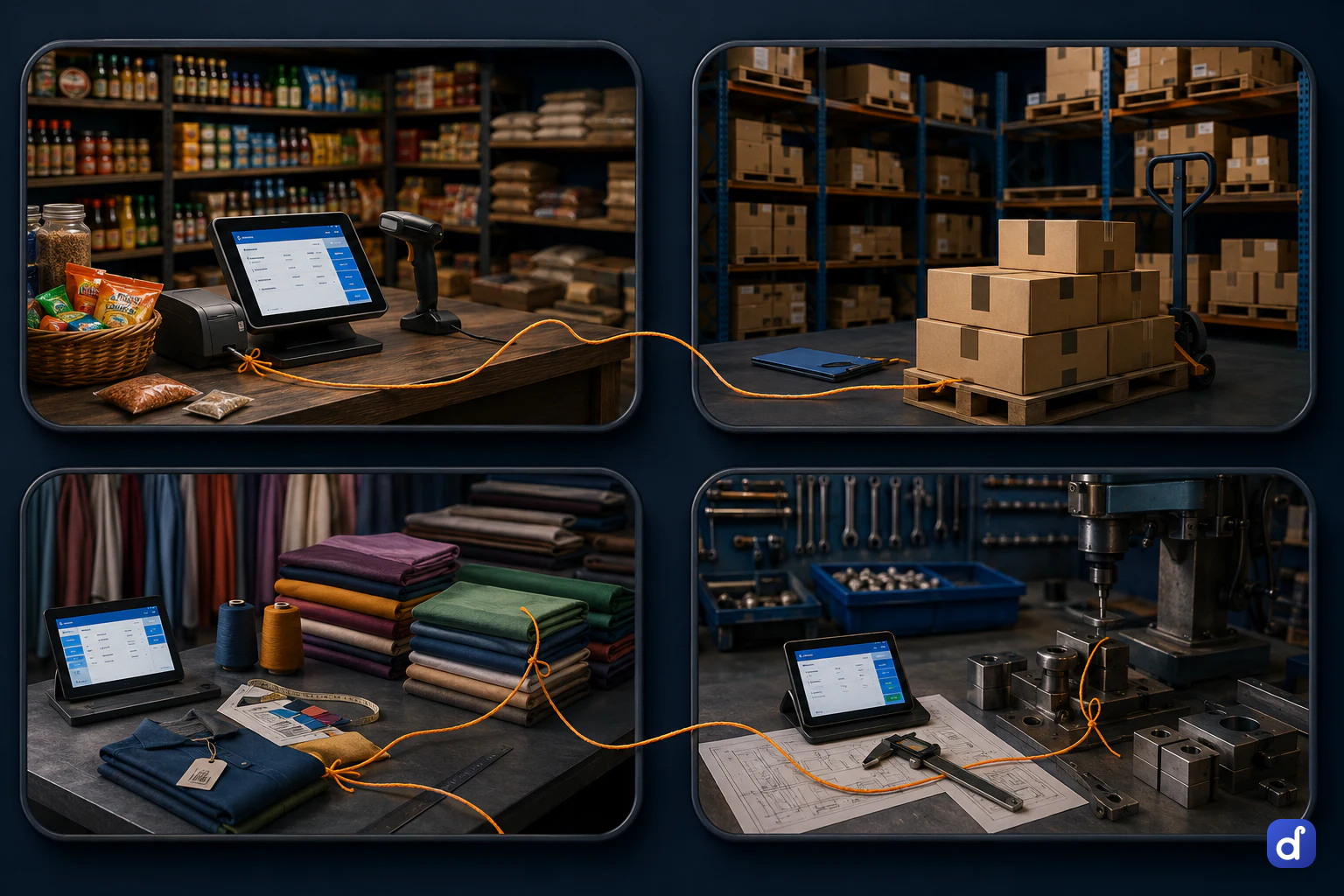
A retail counter, a wholesaler, a pharmacy, a workshop and an apparel unit keep the same books. A pack changes the words and the documents, never the core — and moving from Tally does not mean starting over.
One core. Your trade’s vocabulary on top.
Items, stock, buying, selling, tax, payroll and books work the same way in every business. What changes is what things are called and which documents matter — so that is all a pack changes. Nothing from another trade is forced onto your workspace.
Generic — any trade
The default. Items, stock, buying, selling, tax, payroll and books, in whatever words your shop uses.
Garment
Size and colour matrices, cutting and marker planning, job work, piece-rate wages.
Textile
Roll, shade and batch stock, with dyeing and finishing as their own sub-kinds.
Footwear
Size runs, last and shade, moulding and finishing, shoe-box and carton packing.
Pick a trade. The core does not move — only the words do.
- An item looks like
- Sunflower oil 1L
- Sold by
- litre, packet, case
- The other side is a
- Customer
- The document is a
- Counter bill
- And the pack adds
- Loose weighing, MRP and margin, day close
Underneath, all eight run the same stock ledger, the same double-entry books and the same tax engine. Nothing above is a separate product — it is the vocabulary layer, which is the only part a trade actually needs changed.
Already running Tally? Nothing here asks you to start over.
A shop that has kept its books the same way for fifteen years is not asking whether the cloud is nice. It is asking what happens to the data, to the accountant, and to the way the day already works.
- Your masters and balances
- Import parties, items and opening balances from Tally or Excel yourself, or choose the plan whose card includes a done-for-you migration and our team moves them across.
- Your chartered accountant
- The books stay double-entry with the same ledgers, day book and bill-wise outstanding they already read. Export to Excel or PDF whenever they ask.
- Your machine
- Nothing is installed. The same records open on the counter, the phone and the accountant’s laptop, and nobody carries a pen drive.
- Your data, if you leave
- Every register exports on every plan, with no request and no waiting period. Leaving is a download, not a negotiation.
| Desktop books on one machine | Dhaaga | |
|---|---|---|
| Where it runs | One machine in the back office | Any browser — counter, phone, laptop |
| Who can be in it at once | One, unless you buy more | Everyone with an account, up to the allowance printed on your plan’s card |
| Backups | Somebody remembers to take one | Automatic |
| Data entry | Typed from the document | Read from the document, then posted |
| Counter billing | A separate program | Same records as the books |
| Stock, payroll, production | Add-ons, or another product | Included |
| Getting the numbers out | Export, then rework in Excel | Ask a question, or export |
What it is worth, at your size.
Two things automation returns: the hours somebody spends typing what a document already says, and the money that leaves when nobody compares a bill to the order behind it.
An estimate, not a quote: 4 minutes of handling per document, and 1.5% of purchase value recovered by matching every bill against its order and rate contract. Your figures will differ — the point is the order of magnitude against the monthly price of a plan.
Put one real day through it.
Not a sandbox with sample data — your own bills, your own items, your own customers. By evening you will know whether this runs your business.