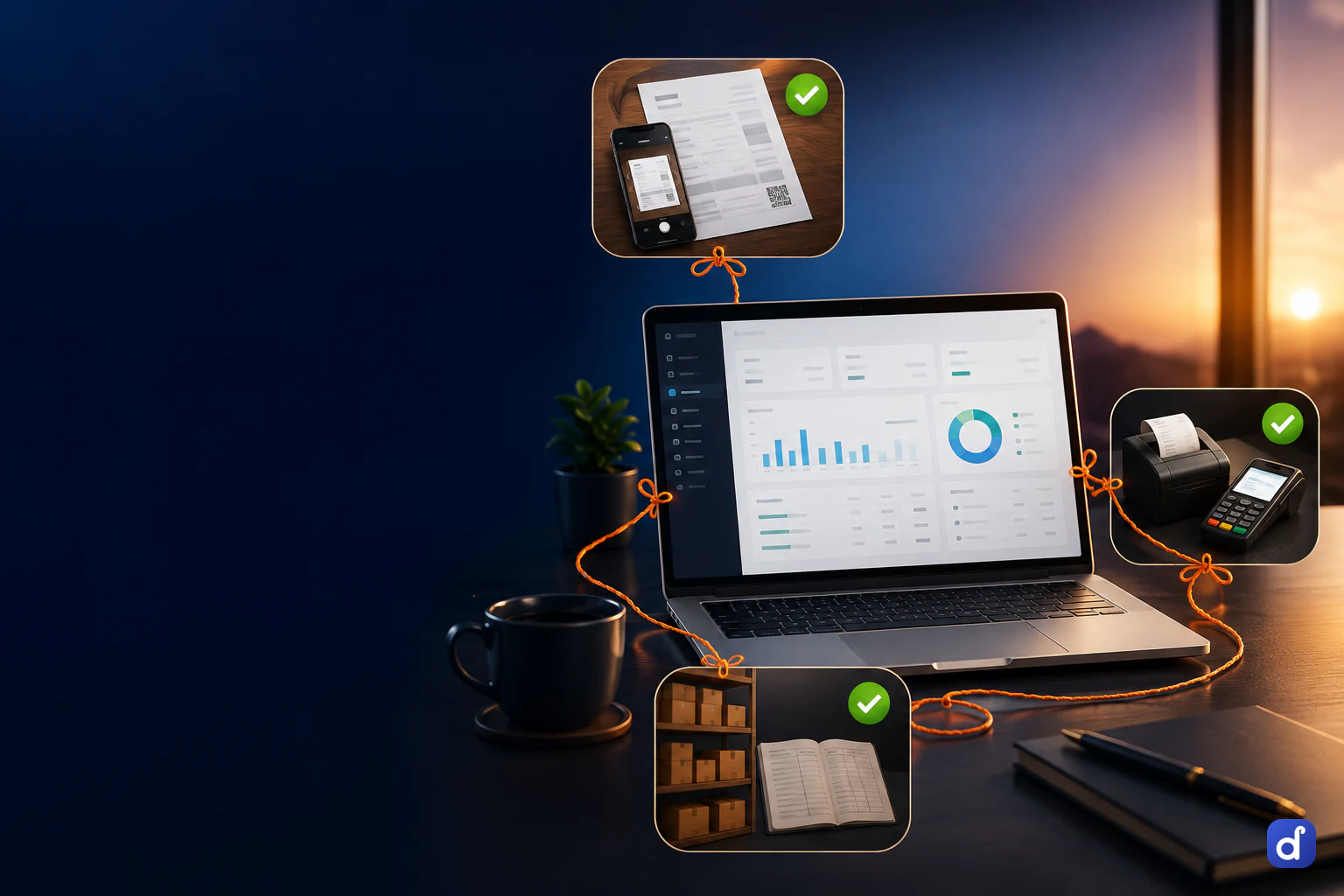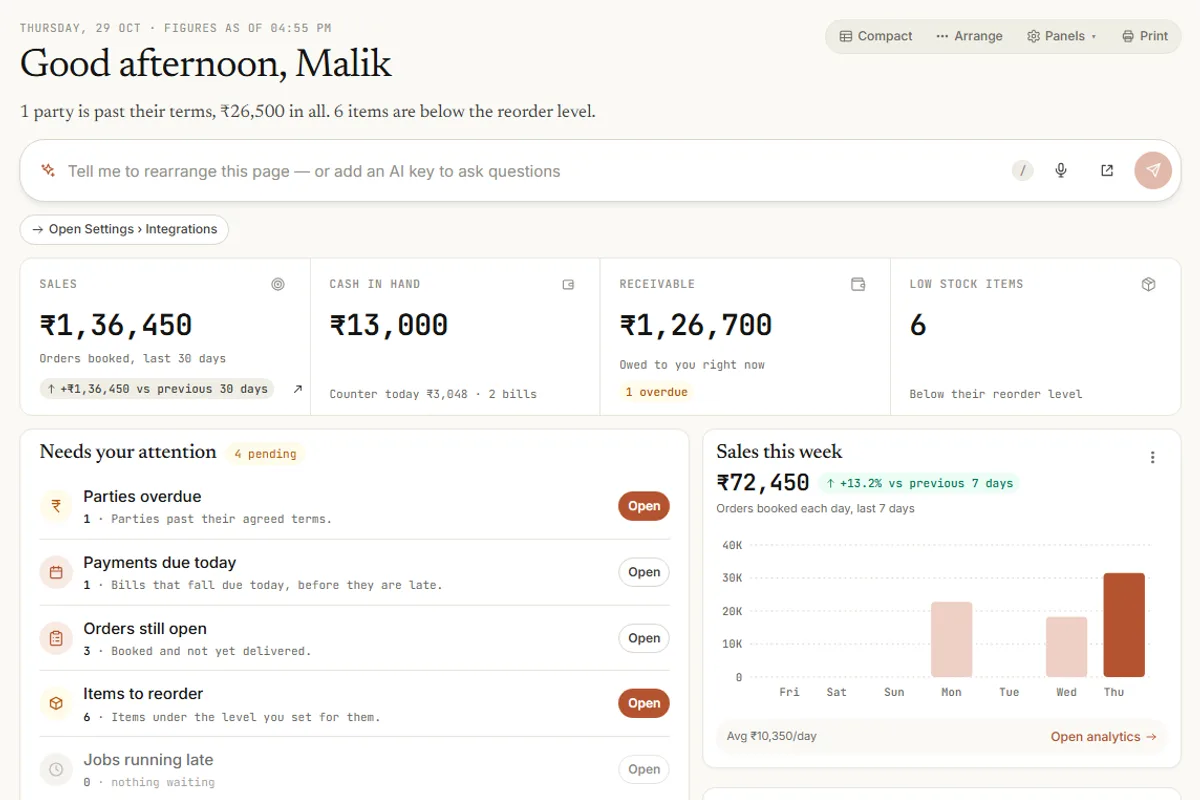
AI chat with an evidence trail
Ask one plain-language question across sales, purchase, stock and ledgers. Dhaaga computes the answer from live records, shows the evidence and suggests the next action.
How it works
How routine work moves through Dhaaga on its own, the four rules that make it safe to leave running, and the exact count of what runs by itself today.
CRM, production, purchase, sales and AI chat do not live in separate islands. These are the screens you work in, and the same business record moves through them from the first decision to the final entry.
Ask one plain-language question across sales, purchase, stock and ledgers. Dhaaga computes the answer from live records, shows the evidence and suggests the next action.
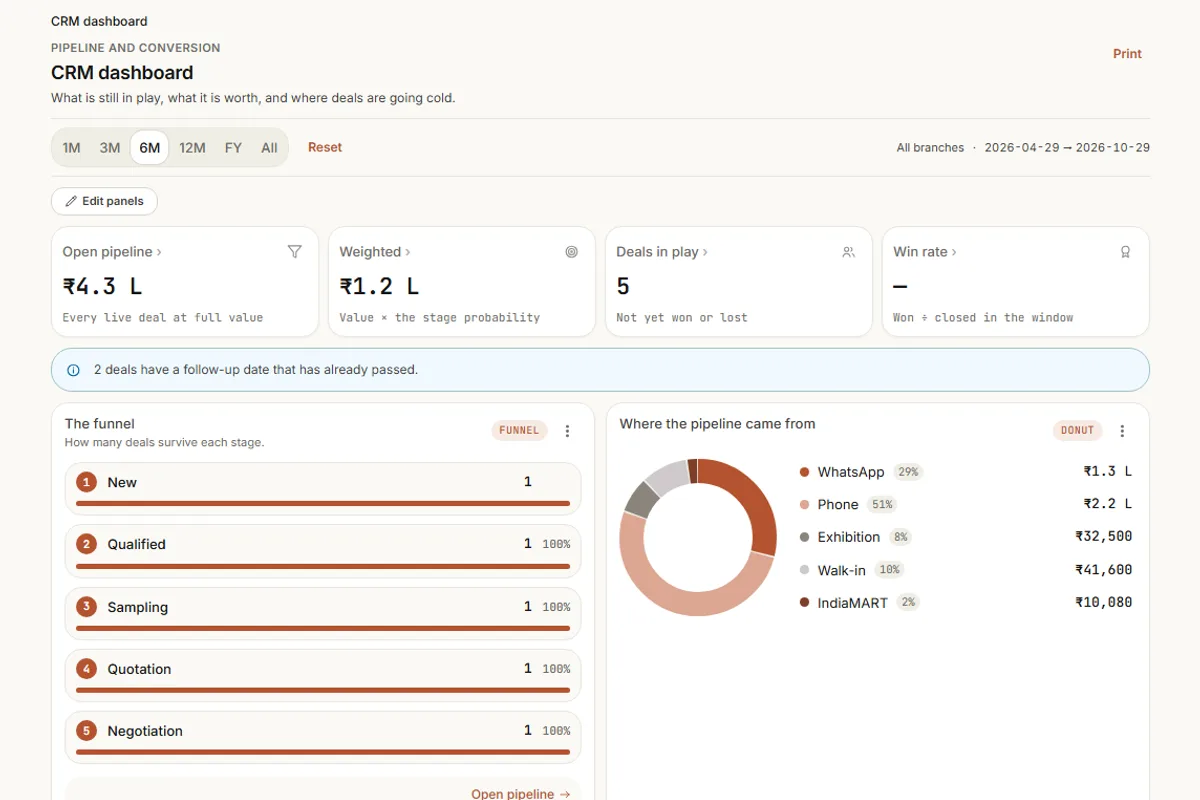
Keep enquiries, qualification, follow-ups, quotations and customer context in one connected pipeline instead of scattered chats and sheets.
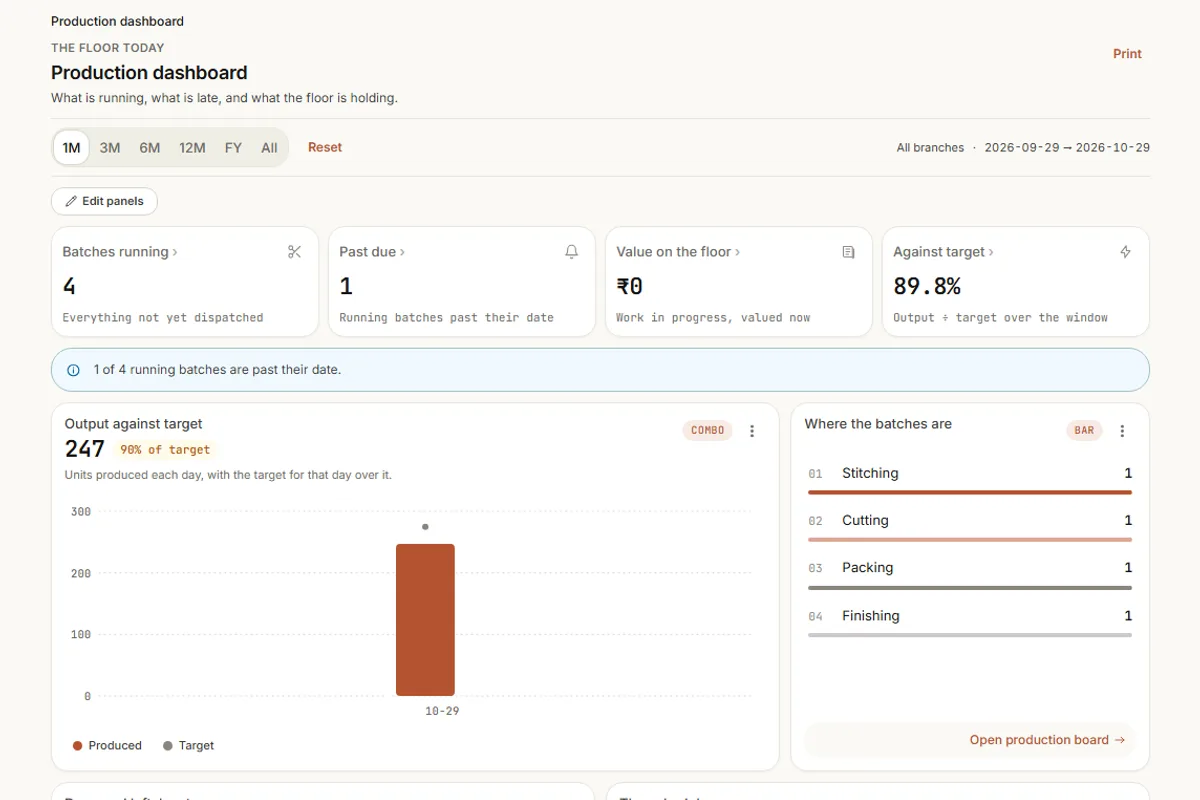
Connect material issue, work in progress, quality checks and finished stock so planning sees the same quantities as the floor and the books.
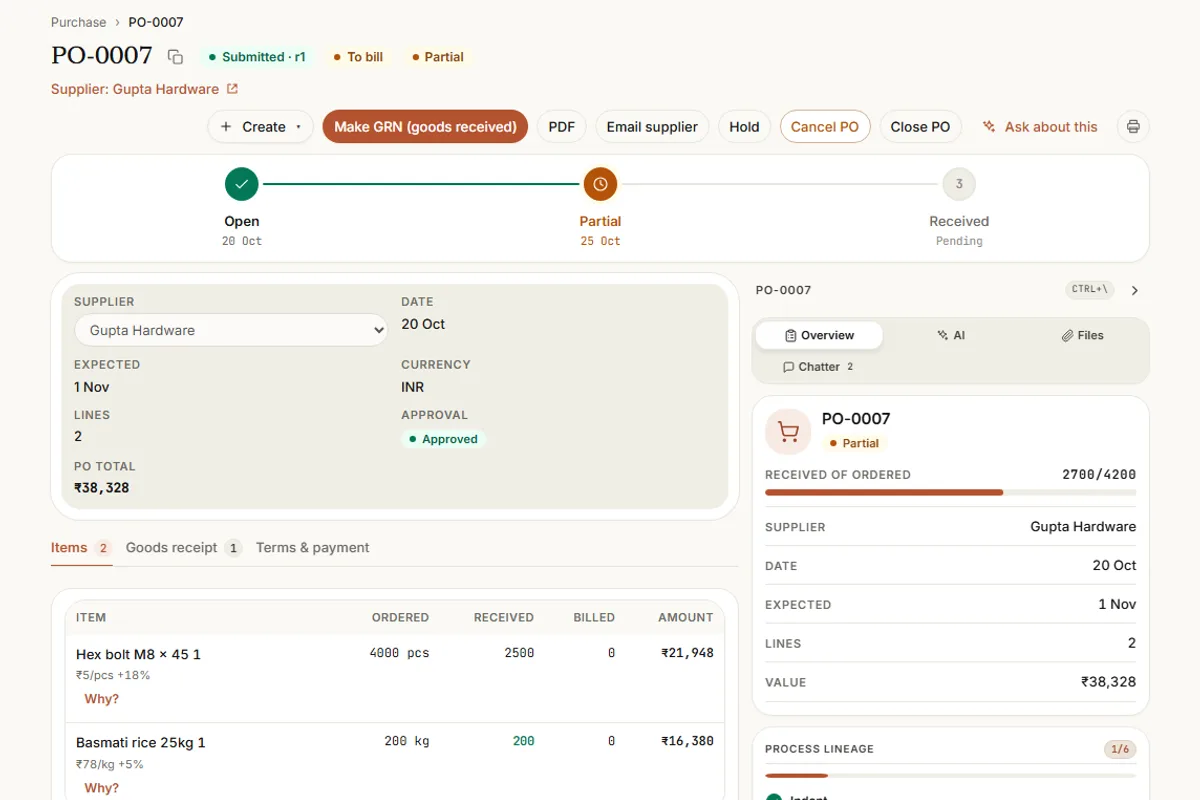
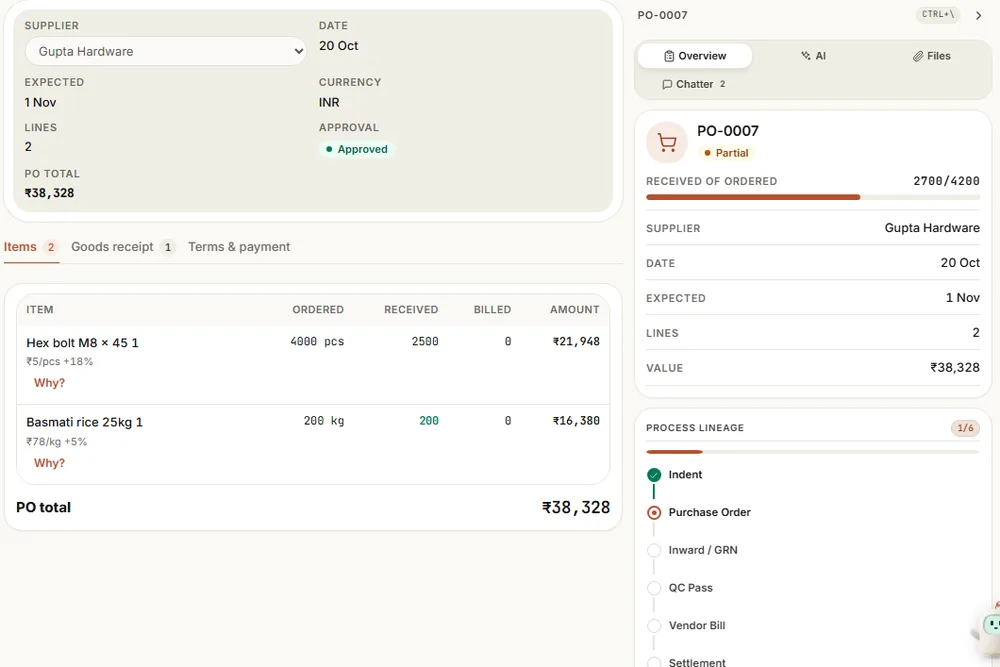
Move from indent and PO to receipt and supplier bill. AI document intake is live; automated three-way matching is shown as the next connected step.
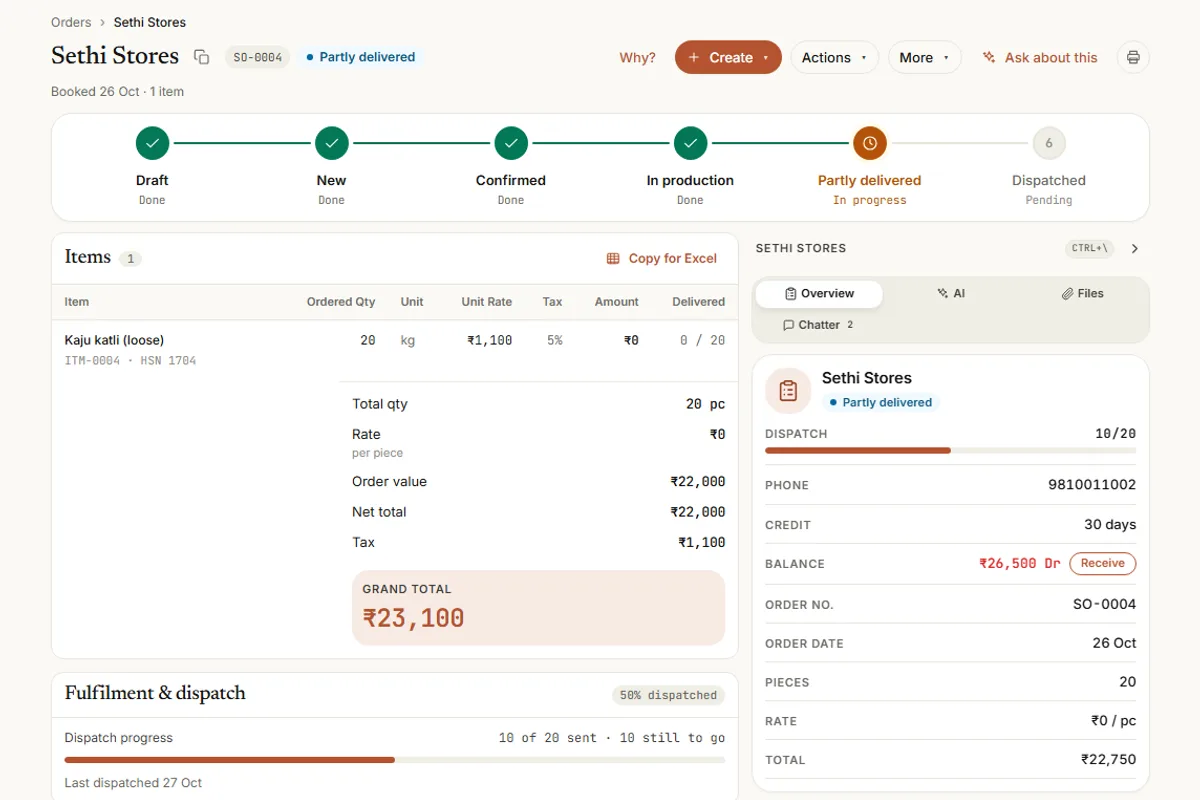
Carry the same record through quotation, order, stock reservation, dispatch, GST invoice and payment. Automated collections follow-up is rolling out.
Screens from the app, shown with sample data from a demo company.
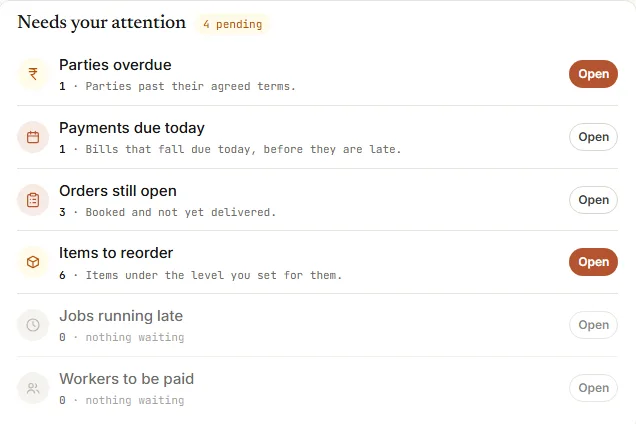
The difference is not a feature list. It is which side of the desk the work sits on — and therefore what you open in the morning.
Four rules the system is built to, not four things we promise to be careful about. An agent earns the right to act alone by its measured score; until then it drafts, and you approve.
Amounts, quantities, rates, dates, accounts and tax come from ordinary code with tests pinning it. A language model chooses wording and classification only. A model having a bad day gives you a badly worded note, never a wrong debit.
Every action stores what it read to reach it — the document, the line, the rule that applied. Open any entry the system made and the reason is attached to it, not reconstructed afterwards.
No automatic action is allowed into the system without a declared reverse, tested as a round trip. Where an exact reverse is impossible the system books a compensating entry with a reason. Nothing is ever silently deleted.
Without a model Dhaaga does less for you and asks more of you. It does not become wrong. A system that gives you incorrect numbers when the model is unavailable was never AI-native, only AI-dependent.
An agent posted this bill. Take it back.
Every ERP in this market says its AI “handles your work”. We would rather hand you the count and let you check it. These numbers are measured from the shipped build, not from a roadmap.
An agent must clear an accuracy gate against 30+ real cases before it may act without a human. A score that falls fails the build.
Every one runs its golden test set on every build, and a score that falls fails the build. Across them, 2,879 cases — 85 of the 89 score a perfect precision and recall in both judge modes.
Cash count — tells you what should be in the drawer and what is not. It is deliberately read-only: it flags, and it can never post to your books.
Reorder watch, dead stock, rate contracts, three-way match, bank statement matching, payslip variance, books-vs-documents drift, advances, attrition risk and more.
If it cannot show the document, the line and the rule that applied, it is not permitted to act at all.
Amounts, quantities, rates, dates, accounts and tax come from ordinary code with tests pinning them. A model chooses wording and classification only — a bad model day gives you a badly worded note, never a wrong debit.
Not a sandbox with sample data — your own bills, your own items, your own customers. By evening you will know whether this runs your business.