Kirana store
Kirana store billing that keeps the khata as it sells
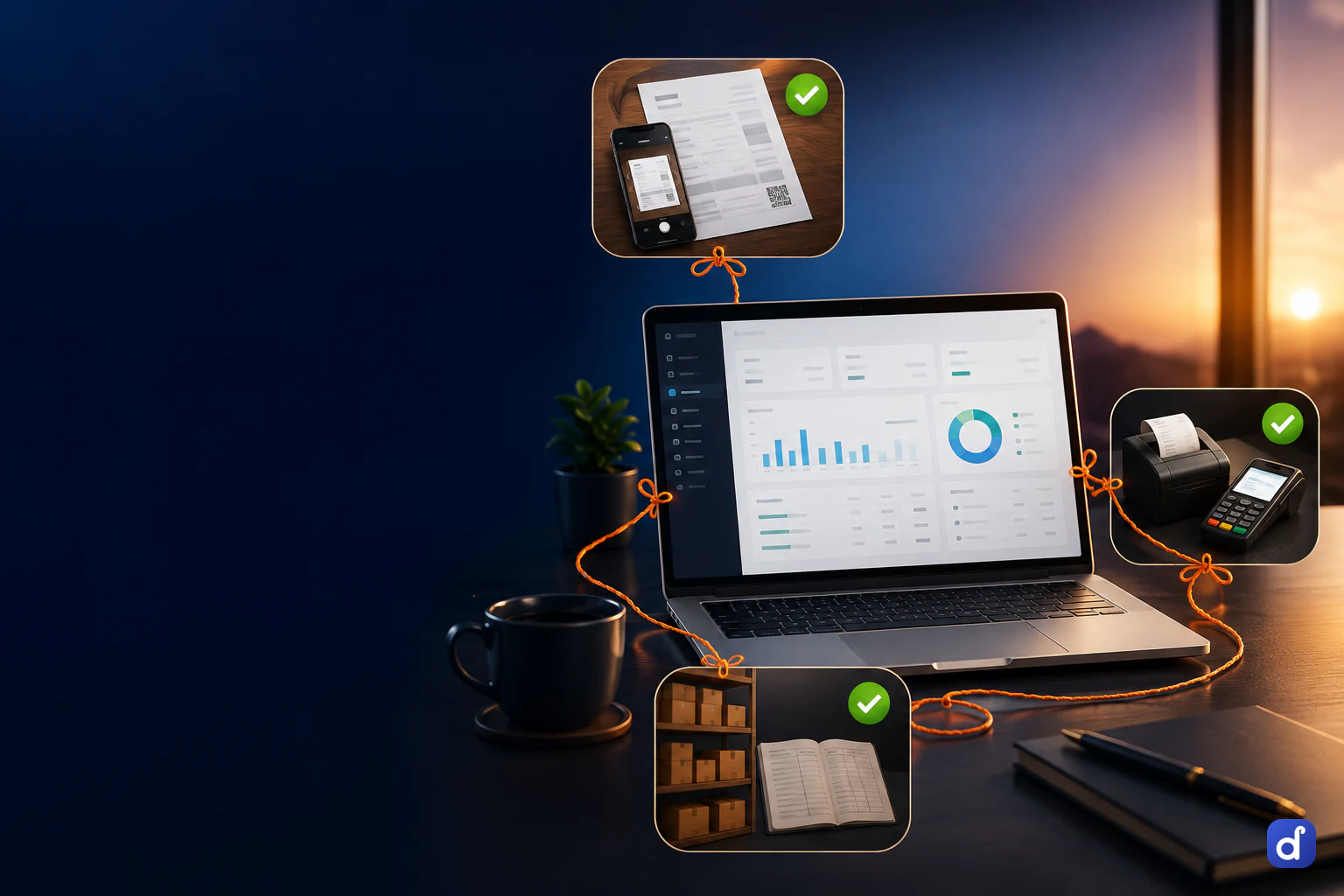
Kirana store billing has to keep up with a queue: a kilo of sugar off the scale, a packet of biscuits by barcode, and a regular who will pay on Sunday. Dhaaga rings all three on one bill, writes the credit into that customer’s khata and takes the goods out of stock as it goes.
What slows a kirana counter down, and what happens instead
Most of the day goes on small bills with mixed units. These are the moments that usually go wrong.
Loose goods weighed twice
Enter your scale’s label layout once, and the counter reads the item and its weight or price straight off the printed label. A label it cannot read is refused rather than guessed.
Udhaar in a notebook
Credit goes only to a named customer and lands in their khata as a bill. With a credit limit set, the counter warns before a sale takes them past it.
One customer holding up the queue
Park the bill while they go back for the atta, serve the next person, then resume the parked bill where you left it.
Short of change
Split one bill across cash and UPI. The payment screen shows your shop’s UPI QR, and the counter checks that the parts add up before it saves.
From the first scan to the closing count
The screens a kirana owner and a cashier use through the day, in the order they use them.
- Set items up once
- Create each item with its unit — kilo, litre, packet or piece — its MRP and its GST rate, or import the list from Excel.
- Ring it up
- Scan the packet barcode, tap the tile for loose goods, or read the scale label. Each tile shows the price and the quantity left.
- Let the scheme apply itself
- Quantity slabs, buy-two-get-one and coupon offers you have set up are applied on the bill, not worked out in your head.
- Take the money
- Cash, UPI, card, store credit or khata, or a mix on one bill, then print on a 58mm or 80mm roll or send it on WhatsApp.
- Close the shift
- Open with a float and close by counting notes, with an X report during the day and a Z report at the end.
One morning bill, start to finish
A regular customer buys loose sugar from the scale, two packets of tea and a bottle of oil, pays ₹200 by UPI and asks for the rest on her account.
| At the counter | What Dhaaga records | |
|---|---|---|
| Sugar off the scale | The scale prints a label for 1.5 kg | Sugar, 1.5 kg at ₹44 a kilo, ₹66, read from the label |
| Tea by barcode | Two packets are scanned | Two packets at ₹130 each, ₹260, with GST inside the MRP |
| Oil by tile | The bottle has no barcode, so it is tapped | One bottle at ₹165 |
| Payment | ₹200 by UPI, the rest on account | A bill of ₹491 with ₹200 to UPI and ₹291 to her khata |
| Afterwards | Nothing more to write down | Stock of all three items reduced, and her ledger shows ₹291 due against this bill |
Questions people ask first.
Yes. Stock the item in kilos and either type the weight or scan the label your weighing scale prints. The weight goes onto the bill and comes off the stock in the same step.
Each customer’s khata lists their unpaid bills and how long each has been due. From that ledger you can send a reminder or their statement on WhatsApp, or a UPI link for the amount due.
Yes. Buy X get Y, quantity slabs, a flat or percentage discount on the bill or on a category, coupon codes and offers that run only within a time window are set up once and applied by the counter.
A phone, tablet or laptop with a current browser and an internet connection. A barcode scanner, a thermal printer and a label-printing weighing scale are optional, and all of them work with it.
Yes. A composition business raises a bill of supply in place of a tax invoice, and the scale labels, the khata and UPI work exactly as they do for everyone else.
Put one real day through it.
Not a sandbox with sample data — your own bills, your own items, your own customers. By evening you will know whether this runs your business.